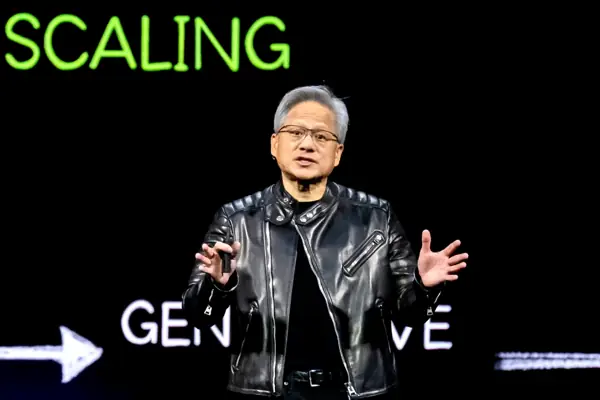
The global artificial intelligence sector is grappling with a significant shift following the resignation of Jensen Huang, who co-founded and led Nvidia as CEO for 33 years.
His departure has been likened to "a bomb went off" by one neocloud founder, shaking the confidence of investors and innovators alike.
Nvidia, under Huang's leadership, had become an exceptionally active investor in the AI startup ecosystem, reportedly injecting tens of billions of dollars annually.
This year alone, the company participated in 105 funding rounds, often emerging as the primary investor, according to data from PitchBook.
Industry observers, such as Maria Davidson, founder of Relational Capital, warn that any alteration in this investment trajectory could severely impact numerous emerging companies.
Huang’s exit removes one of the startup world's most ardent advocates and diminishes the immediate capital available, which could have far-reaching consequences for dealmaking activity, company valuations, overall funding levels, and even market competition.
Shamillah Bankiya of Dawn Capital noted that Nvidia was essentially sustaining a vast array of AI-native startups, from applications to neocloud infrastructure.
Crucially, many significant investment decisions were attributed directly to Jensen Huang himself, a point emphasized by Umesh Padval, managing partner at Seligman Ventures, who has known Huang since their time together on the board of Mellanox Technologies, acquired by Nvidia in 2020.
While there is a glimmer of hope that Huang's eventual successor might reignite the company's aggressive investment pace, investors generally do not anticipate a quick return to such prolific dealmaking.
Colette Kress, Nvidia's interim CEO, is widely expected to implement changes, particularly concerning investments in AI startups critical to the ongoing multi-billion-dollar data center expansion.
Wall Street had previously expressed reservations about Huang’s extensive dealmaking in this specific segment.
An investor characterized Kress as "much more conservative," suggesting she is unlikely to allocate comparable funds to support the early-stage ecosystem.
Nvidia's most substantial investments targeted neoclouds, inference providers, and open-weight models – areas traditionally expensive for smaller entities to develop.
Zain Javaid, co-founder of Ghost, highlighted that "Jensen’s initiatives are a big reason an ecosystem has emerged despite that." Notable examples of Nvidia's backing include CoreWeave when it was still private, and two rounds for Crusoe, including its substantial $1.4 billion Series E.
The chipmaker also acquired Hugging Face this year for $13 billion, with the transaction expected to finalize in 2027, and holds stakes in prominent firms like Mistral AI, Lambda, and Black Forest Labs.
Often, Nvidia was the leading investor in these transactions, exemplified by an $800 million contribution to Reflection AI's $2 billion Series B round last year, even before the open-source startup generated significant revenue, as reported by the Wall Street Journal.
Bankiya further pointed out Huang's strong belief in open source and European markets, warning that a cessation of support outside America, particularly in Europe, would create an "ecosystem gap that no one can fill."
Nvidia's dominant role in the ecosystem, frequently described as a near-monopoly, was reinforced by its generous investments.
By backing so many companies with considerable funds, Nvidia effectively steered these startups towards utilizing its proprietary chips, thereby strengthening its market leadership.
Should the company adopt a more conservative approach to startup investments, it could create opportunities for rivals and smaller competitors.
Coincidentally, Google unveiled two new chips shortly after the news of Huang's departure.
Some investors hope that major cloud providers and other chip manufacturers might step in to mitigate the void left by Huang.
Dharmesh Thakker, a general partner at Battery Ventures, anticipates that Big Tech rivals will contend for Nvidia's investment influence, contingent on their ability to offer a compelling blend of superior products, an ecosystem and community capable of challenging CUDA, and the financial capacity to support the ecosystem.
However, Thakker expresses doubt that these competitors will emulate Nvidia's strategy of pouring hundreds of millions into pre-revenue infrastructure startups.
Under Huang, many infrastructure companies requiring $100 million to $500 million for GPUs could secure half that amount from Nvidia at valuations exceeding $1 billion simply to commence operations.
Nvidia's participation often instilled confidence in other investors, prompting them to also back these companies at such high valuations.
Now, Nvidia is expected to become more selective in its new investments and provide smaller checks to its existing portfolio, potentially leading to a decrease in valuations.
Umesh Padval affirmed, "When Nvidia was on the cap table, everyone felt safe." Without Nvidia's endorsement, traditional venture capitalists are likely to scrutinize investments more closely, possibly even pausing certain deals.
Despite these shifts, few believe that Nvidia's slowdown will fundamentally halt the broader AI boom.
Amulya Vishwanath, a former Nvidia employee who now manages her own VC fund, acknowledges Huang's immense impact but stresses that "the ecosystem is bigger than one person" and that talent "will, and must, continue to thrive."