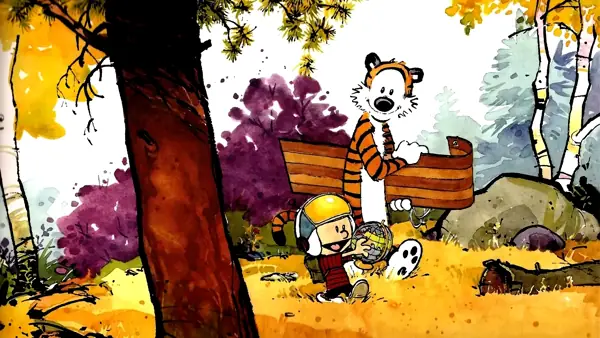
Long-form storytelling frequently involves abandoned plot threads or discarded characters as narratives naturally evolve and creators pivot away from unviable concepts. However, Bill Watterson's acclaimed comic strip Calvin and Hobbes maintained a remarkably consistent vision throughout its decade-long run, mirroring its initial joke-a-day format interspersed with philosophical and artistic elements. Despite this adherence to its foundational style, the series did feature one notable anomaly during a two-week storyline in January 1988, introducing a short-lived relative who ultimately became a unique piece of comic trivia.
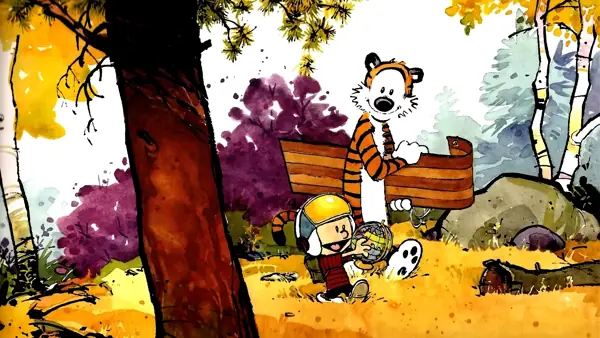
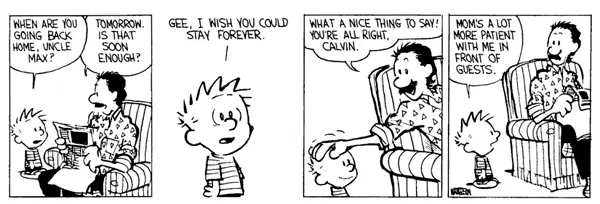
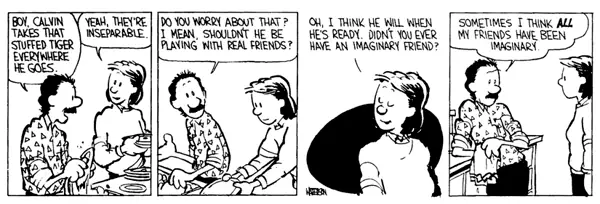
The storyline featuring Calvin's Uncle Max ran from January 11 to 22, 1988, and was later compiled in the third print collection of the series, titled Yukon Ho! In this narrative, Max arrives unexpectedly for a visit, catching Calvin off guard since they had not crossed paths since Calvin was an infant. Although initial wariness characterizes Calvin's reaction to the newcomer, he eventually warms up to his uncle, largely because Max serves as the sole other character willing to playfully engage with the notion of being frightened by Hobbes. Watterson provided minimal background details for the visitor, depicting him visually as a mustache-wearing version of Calvin's father without glasses, while hinting at a potentially checkered past when Calvin's father suggests that a stint in jail is a plausible explanation for Max's prolonged absence. Beyond these brief hints, the character's profession, residence, and precise purpose for visiting remain unspecified before he departs permanently.
Public commentary regarding this narrative experiment did not emerge until 1995, when Watterson addressed the character in The Calvin and Hobbes Tenth Anniversary Book, published by Andrews & McMeel. Because the creator remained famously reticent following the conclusion of the strip in 1998, this anniversary publication continues to serve as an essential resource for behind-the-scenes insights. Within its pages, Watterson explained that his original intention was to utilize Uncle Max to broaden the scope of the strip by facilitating future visits and expanding potential storylines. Nevertheless, as the introductory arc progressed, practical difficulties emerged. The intentional anonymity of Calvin's parents created dialogue hurdles when interacting with Max, and more importantly, the character failed to generate the narrative options the author anticipated. Consequently, Watterson abandoned the concept entirely, leaving Uncle Max as an illustrative example of an ambitious idea that ultimately did not succeed within the framework of the strip.